
Table of Content
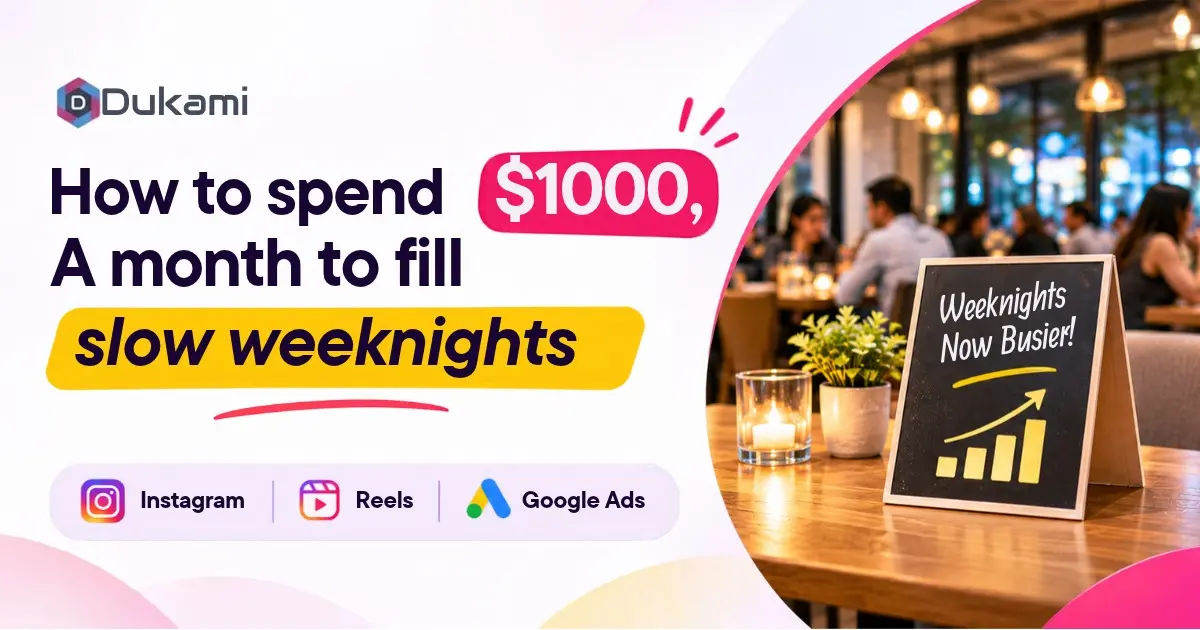
A restaurant owner in Oakland looks at the week ahead. Friday and Saturday are fully booked. Tuesday, Wednesday, and Thursday have empty tables staring back at her.
She has $1,000 a month to spend on marketing. She has already tried boosting posts. The likes came. The diners did not.
That $1,000 is not too small. It is simply being spent in the wrong places, at the wrong times, for the wrong job.
Why Your Restaurant's Slow Nights Stay Empty
Slow weeknights are not a demand problem. They are a visibility and timing problem. People still eat out on Tuesdays. They just do not think of you when they decide where.
The boost button trap. Boosting a post is the easiest button on Instagram and the least accountable. It optimizes for reach and engagement, not reservations. You get likes from people who will never walk in. Meanwhile, the platforms charge you for attention that does not convert.
The $1,000 Split by Goal
Do not split the budget evenly. Split it by what each platform does best. Google captures people who are already deciding. Instagram creates the craving before they decide.
Google captures diners. Meta creates cravings. A restaurant campaign on Google should aim at the searches that happen close to dinner. A Meta campaign should make the food look irresistible hours before the decision. The same $1,000 does different jobs on each platform.
The full allocation at a glance. For a slow-weeknight goal, a workable split looks like this:
| Channel | Monthly Spend | Job |
|---|---|---|
| Google Ads (search) | $600 | Capture "dinner tonight" searches |
| Instagram and Reels | $250 | Build craving and reach non-followers |
| Retargeting | $150 | Bring back people who already engaged |
This is a starting point, not a rule. The ratio moves with your average check and your slowest days.
Google Ads: Capture the "Dinner Tonight" Search
Google Ads works for restaurants only when it targets the moment someone is deciding where to eat right now. Broad food terms waste money. Local, immediate, high-intent phrases fill tables.
Keywords and dayparting that fill a Tuesday. The highest-performing restaurant campaigns target searches like "restaurants near me open now" and "Italian restaurant near me," both averaging around $1.95 per click in 2026. Run these ads only during the hours that match your slow nights. Dinner decisions happen between 3 and 6 PM, so schedule the bulk of the budget into that window. Restaurants using dayparted paid social during decision windows have seen a 22% to 35% lift in mid-week covers.
Branded search and what not to run yet. Always bid on your own restaurant name. It is cheap protection against competitors bidding on you. Skip broad terms like "food" or "restaurant." Skip Performance Max until search is verified and your conversion tracking is clean. Start with $15 to $30 per day and scale based on booked tables, not clicks.
Instagram and Reels: Make Diners Crave Your Menu
Instagram is not a reservation engine. It is a craving engine. Its job is to make someone who was not thinking about your restaurant suddenly want your food at 5 PM on a Tuesday.
Reels for reach, statics for offers. Reels pull roughly 2.25 times the reach of a static post, and about 55% of those views come from people who do not follow you yet. Use Reels to reach new local diners. Use static posts and carousels for offers, announcements, and menu highlights. One format builds awareness. The other converts the people who already follow you.
The 3-2-1 test and the learning-phase trap. Test three Reels, two static images, and one carousel in a month. Let the data tell you which format your neighborhood responds to. Be careful with the learning phase: Meta needs roughly 50 conversions in a seven-day window before an ad set exits learning. At a $250 monthly budget, optimize for cheap actions like profile visits and link clicks, not reservations. Do not judge a campaign until it has cleared that threshold.
Turn a slow Tuesday into a private-event night. Slow weeknights have another use. Promote private dining, group bookings, and event space on the days you cannot fill with walk-ins. A single private event can cover the marketing budget for the month.
Retarget and Measure
Retargeting is the cheapest money you will spend. These are people who already watched your Reel or visited your menu page. They do not need to be convinced you exist. They need a reason to come in tonight.
The three audiences worth building. Build a website visitor audience, an Instagram audience, and a past customer list from your POS or reservation system. Each gets a different message. Visitors get an offer. Engagers get a reminder. Past customers get a reason to return.
Till-side tracking and the four numbers that matter. Platforms grade their own homework. Clicks and reach do not pay rent. Track four numbers: calls, direction requests, offer redemptions, and booked tables. Use unique QR codes per channel, a promo code for Instagram, and a tracked phone number for Google. Compare cost per booked table across channels monthly. That is the only scoreboard that matters.
Your First 30 Days
You do not need to rebuild everything at once. Work through these four weeks in order.
| Week | Focus | What to Do |
|---|---|---|
| Week 1 | Tracking and offers | Set up a tracked phone number and unique QR codes per channel. Create one slow-night offer: a Tuesday prix fixe, a Wednesday happy hour, or a Thursday family deal. |
| Week 2 | Launch Google Search | Build one campaign targeting "near me" and "open now" terms. Daypart it to 3–6 PM. Start at 15–20 per day. |
| Week 3 | Launch Reels and Retargeting | Post three Reels showing the slow-night offer. Launch a retargeting campaign at $5 per day aimed at website visitors and engagers. |
| Week 4 | Verify and reallocate | Check cost per booked table for each channel. Move budget away from what produced nothing. Increase spend on what filled seats. |
Conclusion
Slow weeknights do not need a bigger budget. They need a smarter split. Google captures the dinner decision. Instagram creates the craving before it. Retargeting brings back the people who almost booked.
Track booked tables, not clicks. Kill what does not fill seats. Move the money to what does.
If you want help building this system without guessing, the best restaurant digital marketing Bay Area can set up the tracking, the campaigns, and the reporting. At Dukami, we run Bay Area restaurant marketing built around booked tables, not vanity metrics.
