
Table of Content
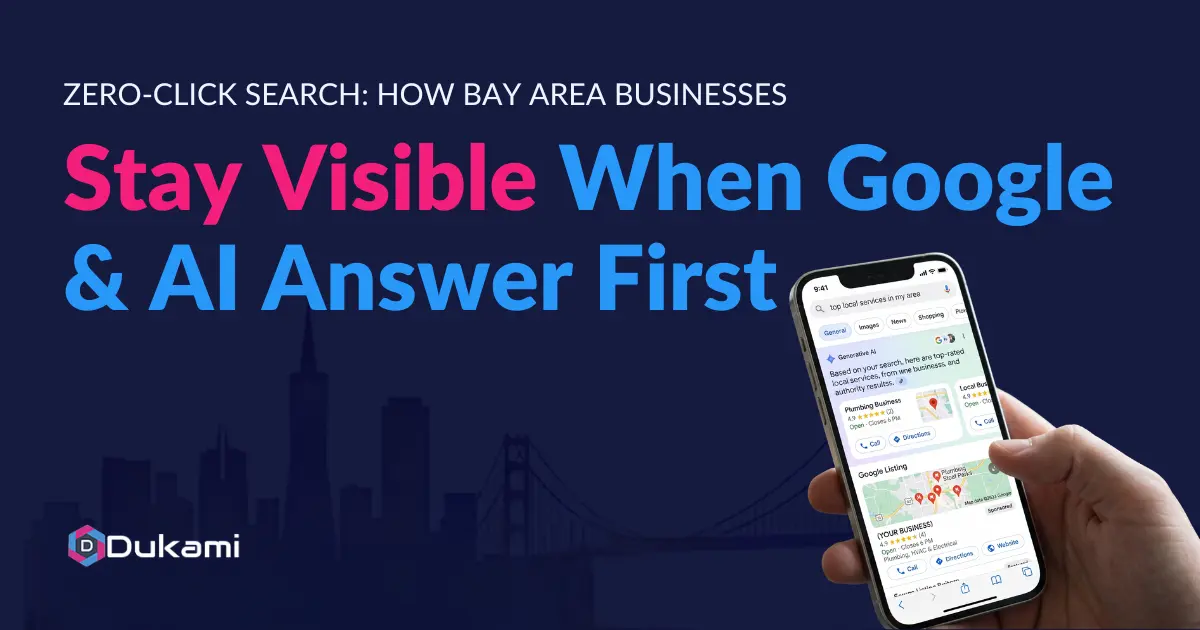
A San Jose dentist checked her rankings on a Monday morning. Everything looked fine. She ranked first for "emergency dentist near me" in her area. But her phone had been quiet for weeks.
Her front desk started asking questions. Long-time patients were calling less. New patient bookings dropped by a third. Nothing in her ads had changed. Her website was the same. So what happened?
Google answered the question before anyone reached her site. The AI Overview named three other dentists first. She was not one of them.
That is zero-click search. And it is costing Bay Area businesses real revenue right now.
This guide gives you a 90-day plan to fix it. No jargon. No guesswork. Just clear steps you can start on Monday.
What Zero-Click Search Means for Your Business
Zero-click search is simple. A customer gets their answer on Google or in an AI tool. They never visit your website. But they still decide. That decision may not include you.
Zero-Click in Simple Terms
Your customer asks a question. Google or an AI tool gives them an answer. They get what they need without clicking anything. Your website never loads. Your phone never rings.
This is not a glitch. It is how search works now. And it is growing every month.
The Four Forms You Need to Know
AI Overviews appear at the top of Google results. They summarize answers from multiple sources. AI Mode is Google's conversational search experience. It answers follow-up questions directly.
Featured snippets and knowledge panels pull answers from websites. They show the answer without a click. The local map pack shows three nearby businesses. It includes reviews, hours, and directions.
Each form answers a question before your site loads. If you are not in the answer, you are invisible.
Why This Is Permanent
Google keeps expanding AI features. Research shows that AI Overviews appeared on 39.4% of U.S. desktop searches in June 2026. That was up from 25.8% a year earlier.
The trend is clear. More AI answers. Fewer clicks.
The Numbers Every Business Owner Should Know
You do not need to be a data analyst. But you need to understand the scale. These four numbers explain what is happening.
About 68% of U.S. Google Searches End Without a Site Visit
Quartz cited SparkToro's June 2026 research for this figure. In 2019, that number was 49%. The shift is accelerating fast.
Two out of every three searches now end without a click. That means your website is not even in the conversation for most searches.
Pew Found Clicks Drop When AI Summaries Appear
Pew Research found that people click a traditional result 8% of the time when an AI summary appears. Without one, that number is 15%. Only 1% click links inside the summary.
The AI summary absorbs the attention. Your link sits below it, ignored.
Ahrefs Reports About 58% Lower CTR for the Top-Ranking Page
Ahrefs found that when an AI Overview appears, the top organic result loses most of its clicks. A 58% drop in click-through rate means ranking first no longer guarantees traffic.
You can hold the number one spot and still lose most of your visitors.
The Silver Lining
Ahrefs notes that AI Overviews can cut CTR by about 58%. But they send a disproportionate share of the remaining clicks to named brands. Visibility and brand now matter more than rank alone.
If AI names you, people remember you. They may not click today. But they will search for your brand tomorrow.
What This Means for You:
| Finding | What It Means |
| 68% of searches end without a click | Most searches never reach your site |
| 8% click rate with AI summary | AI absorbs attention |
| 58% lower CTR for top result | Ranking first is not enough |
| Remaining clicks go to named brands | Visibility beats rank |
Why the Bay Area Feels This First
The Bay Area is not like other markets. People here adopt new technology faster. They ask AI tools for recommendations before they search. That makes zero-click search more urgent here than almost anywhere else.
Searchers Here Adopt AI Tools Early
Your customers are already asking ChatGPT, Gemini, and Perplexity. They ask for the best dentist, the top lawyer, the fastest plumber. The AI gives them one answer.
If your business is not in that answer, you lose the customer. This is happening in the Bay Area more than most markets. Tech-forward customers use tech-forward tools.
Local High-Intent Searches Are Answered Before Your Site Loads
"Near me" queries are the lifeblood of local businesses. Someone searches "emergency plumber San Jose" at 10 PM. They need help now.
Google answers with a map pack and AI summary. Three plumbers appear. Reviews and hours show instantly. The customer calls one of them. Your website never loads.
Competition Is Intense and the Audience Is Multilingual
The Bay Area is one of the most competitive markets in the country. Thousands of businesses fight for the same customers. Ad costs rank among the highest.
The audience also speaks many languages. Mandarin, Hindi, Spanish, Vietnamese, and more. Local trust signals decide who gets named. If your online presence does not reflect the community, AI tools may skip you.
Mini Examples for Four Industries
A healthcare practice in Fremont wants to rank for "dentist near me." An AI Overview lists three competitors. The practice is invisible.
A law firm in San Jose targets "best divorce lawyer in Fremont." A featured snippet answers with a competitor's name.
A home services company in Oakland wants "emergency plumber San Jose." The local map pack shows three other plumbers.
A B2B tech firm in Mountain View seeks "IT support near me." ChatGPT recommends a competitor it has cited before.
Different industries. Same problem. The answer comes first.
Which Businesses Lose Most, and Which Barely Notice?
Not every business is susceptible to the risks of zero-click searches . Informational content loses the most traffic. Transactional and local searches still drive clicks. Knowing where you stand helps you prioritize.
Informational Queries Lose the Most
Search Engine Journal analysis puts the AI Overview hit rate at 92.3% for "why" queries and 85.7% for "what" queries.
If your leads come from blog posts that answer questions, you need to act. AI answers those questions directly. Your blog does not get the visit.
Transactional and Local Queries Are Less Affected
Transactional CTR fell far less than informational CTR. When someone wants to buy, book, or call, they still click.
Local intent still drives calls and visits. "Plumber near me" still produces phone calls. The click may happen on the map pack, not your website. But the call still comes.
Self-Diagnosis Checklist
Ask yourself these questions:
- Do 70% or more of your leads come from blog traffic?
- Do you rely on informational content to attract customers?
- Is your Google Business Profile incomplete?
- Do you have fewer than 50 reviews?
- Are you invisible in ChatGPT and Gemini?
If you answered yes to two or more, you are already losing visibility in zero-click searches.
7 Strategies to Stay Visible (Ranked by Impact)
These strategies are ranked by impact. Start at the top. Move down as you complete each one. Local and brand signals come first because they matter most for local businesses.
1. Own Your Google Business Profile
Your Google Business Profile is your highest-impact asset. Complete every field. Add your categories, services, photos, and hours. Post weekly updates. Answer questions.
An incomplete profile loses customers before they consider you. A complete profile feeds the local map pack and AI answers.
2. Win Reviews and Respond to Them
Reviews feed local packs and AI answers. Ask every happy customer for a review. Make it easy with a QR code or direct link.
Respond to every review within 48 hours. Thank positive reviewers. Address negative reviews calmly. Future customers read your replies too.
3. Build Brand and Entity Authority
AI systems need to trust you before they cite you. Build consistent signals across the web. Use the same name, address, and phone number everywhere.
Create an About page with real credentials. Add author bios to your content. Claim profiles on Yelp, LinkedIn, and industry directories.
4. Write Answer-First Content
Start every page with a direct answer. Put a 40–60 word answer under each question heading. Then add depth below.
This is how AI extracts your content. If the answer is buried, AI skips it. If the answer is clear, AI cites it.
5. Add Schema Markup
Schema tells search engines and AI what your content means. Add Local Business, FAQ, Service, and Review schema to your pages.
Schema is not optional anymore. It is how you speak to machines. Without it, AI has to guess. With it, AI knows exactly what you offer.
6. Publish What AI Cannot Copy
AI cannot create original data. It cannot share local case studies. It cannot write the "Bay Area cost of X" article.
Publish content only you can produce. Original research. Local pricing guides. Customer success stories. Unique content earns citations.
7. Build Owned Channels
You do not control Google. You do not control AI answers. But you control your email list and SMS list.
Collect emails. Send helpful content. Use remarketing to stay visible. Owned channels protect you when search changes.
Effort vs. Impact Matrix
| Strategy | Effort | Impact |
| Google Business Profile | Low | High |
| Reviews | Low | High |
| Brand and entity authority | Medium | High |
| Answer-first content | Medium | High |
| Schema markup | Medium | Medium |
| Original content | High | High |
| Owned channels | Medium | Medium |
How to Measure Success When Clicks Fall
Traffic used to be the main metric. Now you need new ways to measure visibility. These four methods show whether your efforts are working.
Track New Metrics
Stop watching sessions. Start watching impressions. Track Google Business Profile calls. Monitor direction requests. Count form leads and booked appointments.
These metrics show real business impact. A phone call is worth more than a pageview.
Watch Branded Search and Direct Traffic
Branded search growth in Google Search Console means people remember you. Direct traffic in analytics means they typed your URL.
Both signal that AI citations and local visibility are working. Even if they did not click the first time, they came back.
Run the AI Visibility Test
Run 20 test prompts monthly in ChatGPT, Gemini, and Perplexity. Ask about your services in your city. Track whether your business appears.
This is the plain-English version of "share of model." It tracks how often AI mentions you. Do this every month.
Ask Customers How They Found You
Add one question to your intake form. "How did you hear about us?" It is the simplest attribution tool you have.
Customers will tell you if they found you through AI, Google Maps, or a friend. Their answers reveal what is working.
5 Mistakes to Stop Making Today
These mistakes cost you visibility. Stop them now. Your competitors may already be ahead.
1. Judging SEO Only by Traffic
Traffic is not the goal. Visibility and revenue are the goals. If AI names you but does not send a click, you still win brand recognition.
Track calls, bookings, and revenue. Stop obsessing over sessions.
2. Publishing Thin, Generic Blog Posts
AI skips thin content. It cites original, specific, local content. Generic posts about "why SEO matters" will not earn citations.
Write content that only you can write. Share local insights. Publish original data.
3. Hiding Key Facts in PDFs or Images
Pricing, hours, and services belong in plain text. AI cannot read images. It cannot extract text from PDFs easily.
If your menu is a PDF, AI cannot see it. If your pricing is an image, AI cannot cite it. Move everything to plain HTML.
4. Ignoring Reviews and Local Listings
Reviews and listings feed AI answers. An incomplete profile or few reviews means AI skips you.
Claim every listing. Respond to every review. Keep your information accurate everywhere.
5. Waiting
Your competitors are already being cited. Every month you wait, they gain ground. The shift to zero-click search is not coming. It is here.
Start today. Pick one strategy. Complete it this week.
Your 90-Day Action Plan
This plan breaks the work into three phases. Each phase builds on the last. You do not need to do everything at once.
Days 1–30: Audit and Fix the Foundation
Audit your Google Business Profile. Fix your name, address, and phone consistency. Add schema to your key pages. Run the AI prompt test to see where you stand.
This month is about diagnosis. Find the gaps. Fix the basics.
Days 31–60: Rewrite and Build Reviews
Rewrite your top 10 pages answer-first. Put a 40–60 word answer under each heading. Launch a review request system. Respond to all existing reviews.
This month is about content and reputation. Fix what AI sees. Build trust signals.
Days 61–90: Publish and Measure
Publish original local content. Start an email nurture sequence. Set up your new dashboard. Track impressions, calls, and AI citations.
This month is about momentum. Build on the foundation. Measure what works.
Conclusion and CTA
The game has changed. It is no longer about being clicked. It is about being chosen. The businesses that win are the ones that invest in visibility, not just rankings. Working with an experienced SEO agency can help you improve your visibility across Google and AI search.
You do not need to fix everything today. Start with one strategy. Complete it this week. Then move to the next. Small steps compound over time.
Ready to see where you stand?
Request a free Zero-Click Visibility Audit from Dukami. We will show you where you appear in AI search, local packs, and branded search. Then we will give you a plan to fix the gaps.
