

Table of Content
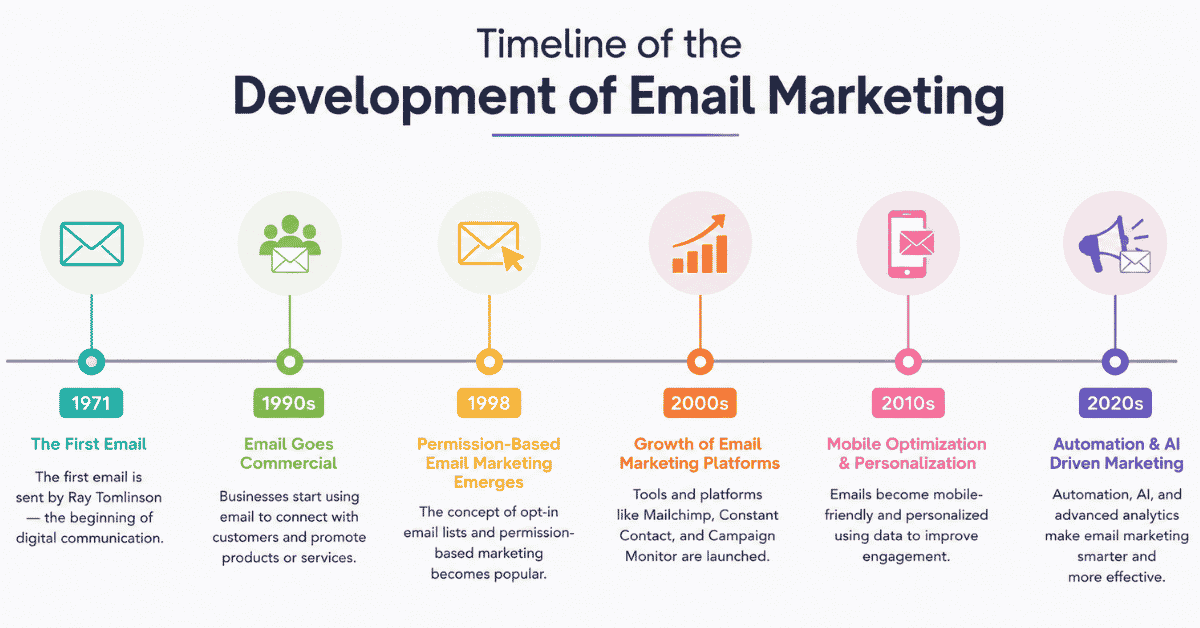
Email marketing has proliferated unscathed despite the advent of other technologies. Ray Tomlinson sent the first electronic mail in 1971. Seldom did anyone know it would become a major marketing channel. Over the ages, marketers have leveraged innovative technologies to promote products and services. However, none could match Gary Thuerk from Digital Equipment Corporation. He promoted his company's computers through email. As part of this, he sent the first email blast to 400 recipients. This resulted in $13 million in sales. Unfortunately, people also consider this the first spam message. Today, email is a core component in digital marketing strategies.
A spam message means the sender had no specific permission from the recipient.
The internet went live in 1991. Subsequently, email usage increased dramatically. Universities and corporations mainly used it for communications. Hotmail launched the first free web-based email service. After that, there was no turning back.
We define email marketing as using emails to market and sell products. It also helps drive brand awareness and increase brand recall. Additionally, it builds customer loyalty and improves reputation through personalised approaches.
Email marketers exploited every technique to reach recipients' inboxes. Consequently, the definition of spam messages increased in scope. This happened after free web-based email emerged. Consulting with an expert agency before running email campaigns is a good idea.
Today, spam messages include more than just unsolicited emails. They also include:
- Irrelevant mails that land in your inbox
- Mails that contain malicious programs for hacking
- Mail blasts that populate the recipient's inbox, hoping to gain priority
- Mails that ask for private financial information and confidential data
Timeline of the development of email marketing
Essentials of Email Marketing
Email Marketing requires a few essentials, like:
(a) Email Recipient's List
This list includes the recipients you want to email. You can create the email recipients' list in many ways:
- Keep a sign-up form on your website for newsletter subscription
- Analyse your network on social media platforms and gain email addresses
- Promote your newsletter on social media platforms and keep a sign-up button
- Get email addresses from any data and survey firm
You can build the email recipient list through multiple other ways.
Now, you create the list of your target audience through various stages:
- Create the first list of email addresses, which should include a wide audience
- Conduct a recipient inbox email test to verify the email address validity
- Filter out audiences based on geographic locations, demographics, income levels, and psychographics
- Create an ideal buyer persona and filter out addresses that don't fit
- Send the first email blast to the filtered list
- Analyse the responses on metrics like open rate and click-through rate
At this stage, you filter out emails likely to be non-responsive. You also exclude those who clearly expressed no interest in promotional emails. Moreover, many people mark emails from unknown addresses as spam. Therefore, you should always remember this.
After three or four filtering rounds, you get the probable list of prospects. Then, you need to pitch in with your email marketing strategy.
Note: You identify your probable customers better with every email campaign. Consequently, the email list grows solid with time. After all, 'EXPERIENCE SPEAKS'.
(b) Email Sending Software
Many software programs help you send mass emails to your target audience. Some of the leading ones in the field are:
- Send Pulse
- Send in blue
- Mail Chimp
- idigitalio
- snov.io
- Mail pro
- Send blaster
- Sendy and so on.
All these software programs allow you to:
- Upload the email addresses of your target audience
- Set the geographic and other filters
- Schedule the time of sending the emails
- View analytics showing open rate, click-through rate, read rate, and bounce rates
These email sending software programs provide detailed reports and analysis of your campaign.
(c) Email Template
You need a very good email template. It should consist of a header and a footer. You can include social icons in these sections. Additionally, include body content, CTAs, images, graphics, videos, and subject lines.
(d) Email Testing
You need to test several elements before you execute the campaign. Test your email list and the efficacy of your email content. Also test the CTAs, header, footer text, and images.
You can conduct multiple tests, such as:
- Split Testing
- A-B Testing
- Multivariate Testing
- Spam testing
- E-Mail template, Code testing, and so on
(e) Effective Email Landing Page
You need an effective email landing page. It should contain all your service and product propositions. Additionally, include pricing, offers, and all the USPs of your organisation. You need to put a simple subscription or order form on this page. This will help achieve the goal of the email marketing campaign. The form can facilitate placing orders, newsletter subscriptions, or brand enquiries.
Now, you can carry out your email marketing campaigns with ease. This is possible when you have all these essentials in place.
Email Marketing ranks among the most remunerative forms of marketing. Companies earn an average return of $44 per dollar spent. Moreover, setting up an email campaign is cost-effective.
So, what are you waiting for?
Hire Dukami to generate high returns and run successful email campaigns for your organisation
Don't wait to bring your digital dreams to life. Contact us now to schedule a consultation and let's take the first step towards your project's success.
